
One of the world’s youngest populations is found in Africa. Millions of children and young people around the continent aspire to work as doctors, engineers, educators, entrepreneurs, or innovators. However, there are still significant issues with education systems in many African developing nations, such as inadequate infrastructure, a teacher shortage, a lack of educational resources, and unequal access to digital technology. Education is still one of the most powerful instruments for social change and economic expansion in spite of these challenges.
To enhance learning results throughout African countries, governments, international organizations, and digital firms have started funding educational innovation in recent years. There is promise for a better future thanks to the growth of internet connectivity, smart learning technology, and digital education. EdTech, or education technology, is gradually transforming classrooms and opening doors for students in neglected and remote areas.
Over 366 million children and young people live in Eastern and Southern Africa alone, according to UNICEF. Millions of people still do not have access to high-quality education, and many students have difficulty with reading and numeracy. Because nations cannot fully profit from their youthful populations without educated and talented citizens, this education gap has an impact on economic development.
The lack of trained educators is a significant problem in developing African nations. Many rural schools have overcrowded classrooms and a shortage of teachers. One teacher may be in charge of more than fifty pupils in some places. This lowers the quality of learning and restricts individual attention. According to UNESCO, there is still a significant teacher shortage in Africa, particularly in the fields of science, technology, engineering, and mathematics.
Poverty is another significant concern. Families in low-income neighborhoods frequently find it difficult to pay for internet access, uniforms, school supplies, and transportation. Some kids drop out of school early in order to provide for their families. Gender discrimination, early marriage, and limited educational chances are obstacles that girls in particular must overcome. As a result, disparities in education continue to be a major issue in many African countries.
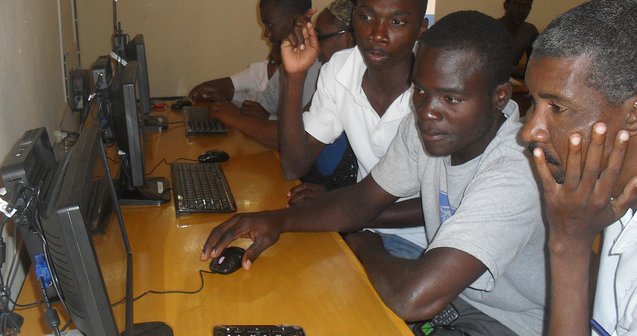
Many of these problems are now being addressed by technology. Even in isolated areas, kids are able to access educational materials thanks to mobile phones, tablets, solar-powered PCs, and online learning platforms. Digital learning became even more crucial during the COVID-19 pandemic. Organizations and governments came to the realization that technology could support education during school closures.
Digital learning helps eliminate educational inequalities in low-resource settings, according to UNESCO. Radio-based learning programs and offline educational software are being developed in nations with limited internet connectivity. With these methods, students can continue their education without relying solely on fast internet connections.
Leading nations in educational innovation include South Africa, Kenya, Ghana, and Rwanda. For instance, Rwanda has made significant investments in digital schools and teaching young students to code. Digital literacy initiatives and online learning environments have been implemented in Kenyan primary schools. The goal of these initiatives is to get young Africans ready for professions in innovation and technology.
African educational systems are also starting to be impacted by artificial intelligence (AI). Lessons can be tailored to each student’s needs using AI-powered learning tools. Certain programs include virtual instructional assistance, language translation, and automatic feedback. If used appropriately, experts think AI might help solve the teacher shortage and raise educational standards. However, many communities continue to face obstacles due to inadequate infrastructure and unequal access to technology.
Technology in education cannot address every issue on its own. Electricity, internet access, libraries, and secure learning environments are still lacking in many schools. Governments must fund curriculum development and teacher training in addition to continuing to invest in physical infrastructure. Enhancing learning outcomes and developing practical skills should be the main goals of educational reforms in addition to growing enrollment.
Another crucial area for improvement is vocational and technical education. In the fields of agriculture, engineering, construction, renewable energy, healthcare, and digital services, many African economies require skilled labor. African nations can lower unemployment and equip youth with employable skills by bolstering their vocational training initiatives. The significance of connecting educational systems to labor market demands has been emphasized by UNESCO and UNICEF.
Participation in the community is equally essential for academic success. To support students, non-governmental groups, parents, teachers, and local officials must collaborate. Community-led projects have assisted in constructing schools, supplying school lunches, and promoting females’ education in numerous villages. These regional initiatives show that shared accountability is necessary for sustainable educational progress.
Africa’s higher education institutions are likewise changing. Universities are embracing innovation hubs, research collaborations, and online learning platforms more and more. However, issues including congestion, insufficient money for research, and subpar infrastructure still have an impact on the quality of higher education in many developing nations. Both scientific advancement and economic competitiveness depend on investments in universities and research facilities.
International collaborations are still crucial for assisting Africa’s educational transition. In order to increase access to high-quality education and chances for digital learning, organizations like UNICEF, UNESCO, the African Union, and the World Economic Forum continue to collaborate with governments. In order to improve educational systems, these collaborations offer financial support, teacher preparation, policy assistance, and technical resources.
How well nations spend in education now will have a significant impact on Africa’s future. A population with a high level of education can boost economic growth, foster innovation, lower poverty, enhance healthcare, and fortify democracy. People who have received an education are more equipped to solve problems, think critically, and make constructive contributions to society.
There are optimistic indications of development despite the fact that there are still major challenges. Over the past 20 years, school enrollment rates have increased in many African nations, and learning opportunities are still being expanded by digital technology. The importance of education for sustainable development is becoming more widely acknowledged by communities, governments, and international organizations.
In conclusion, technology and education are strong forces that have the potential to change Africa’s developing nations. Millions of young Africans are finding new opportunities because to innovation and investment, despite ongoing issues like poverty, inadequate infrastructure, teacher shortages, and digital inequality. African countries can unleash the full potential of their youth and create a better future for future generations by bolstering education institutions, encouraging digital inclusion, and supporting lifelong learning.
You acknowledge that you have read our Privacy Policy and agree to our Terms by messaging ChatGPT, an AI chatbot. Refer to Cookie Preferences.
Don’t divulge private information. Our models may be trained by reviewing chats. Find out more.